
Academy Malaya Unicorn
Location
Here's Why...
Enter Malaysia – a tropical, Muslim-majority country in Southeast Asia where its citizens live in multi-racial and multi-religious harmony. Comprising of 13 states and three federal territories and headed by the only elected constitutional monarch in the world, Malaysia is a vibrant and diverse parliamentary democracy with a population of over 30 million, making is the world’s 44th most populous country in the world.
The federal territories host the nation’s largest city of Kuala Lumpur which houses the country’s largest commercial and financial institutions, as well as the federal administrative capital city of Putrajaya. While English is commonly spoken, the official and national language of Malaysia is Bahasa Melayu (Malay language). Malaysian English, a local vernacular more commonly known as Manglish, is a mish-mash of Malay, English, Mandarin and Tamil.
Living Environment
Home to a diverse group of races and religions, the melting pot that is Malaysia is reflected in the languages used on a daily basis, as well as its rich traditional and modern influences on the country’s architecture and gastronomical delights. A culinary haven for many, Malaysian food has influences from all around the region. Dishes from Malay, Chinese, Eurasian, Indian, Thai, Javanese, and Sumatran cultures often feature more frequently. From staples like rice and noodles to exotic meats, Malaysian cuisine has it all and no picky eater will go hungry. More commonly sought out are its street vendors who dish up mouth-watering fare but do ensure food is served piping hot to dissuade any upset stomach.
Home to four UNESCO World Heritage Sites, amongst them, Kinabalu National Park boasts one of the highest mountains in Southeast Asia. An ecotourism hotspot, the country is home to an estimated 20% of the world’s animal species. The Malaysian landscape is as varied as it is culturally diverse. Pristine beaches line its coast and its biodiversity-rich rainforest offer many adventures to those who venture forth.
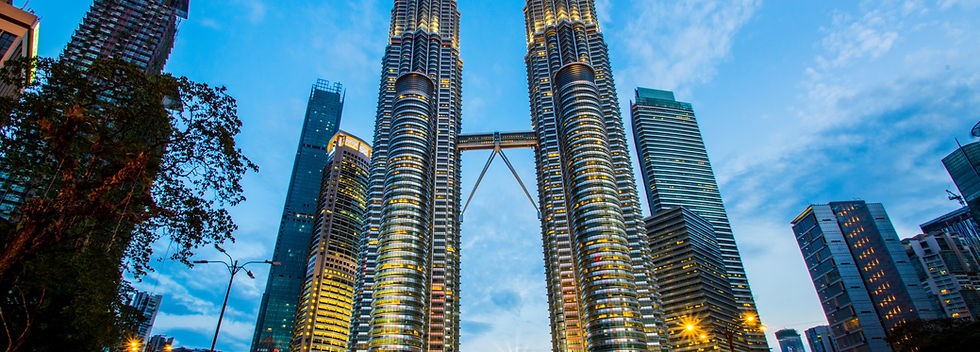
Most of Malaysia’s inhabitants reside in major cities and many are a collection of Chinese, Indian and European cultural influences. The commercial capital, Kuala Lumpur, is home to old colonial buildings, modern busy shopping districts such as Bukit Bintang and skyscrapers such as the iconic, 451m-tall Petronas Twin Towers. Most of the population are settled in the centre of peninsula Malaysia, where 70% out of approximately 32.6 million Malaysians reside in developed cities.
Transportation throughout Malaysia reflects its status as an emerging economy. Paved roads and bustling highways link small towns to large cities. Rail transport is available in most parts of the country and comprises heavy rail (KTM) and rapid transit system such as MRT, LRT and Monorail (Rapid Rail). Heavy rail is mostly used for intercity passenger and cargo transport, while Rapid Rail are used for intra-city urban public transport. More rapid transit networks, including in Kuala Lumpur, Penang, Johor and Sarawak, are currently under construction to improve the overall’s public transport system.
The main gateway to the rest of the world, Kuala Lumpur International Airport (KLIA) is also Malaysia’s busiest airport. In 2019, KLIA was the world’s 22nd-busiest airport in terms of total passenger traffic.
Economy
Malaysia has developed from a mainly agriculture- and primary industry-based economy to a successful exporter of electrical and electronic parts and appliances, chemicals, heavy machineries, as well as IT and financial services.
Data from the Malaysia Economic Monitor, World Bank shows that growth in Malaysia accelerated for the past few years with year-on-year growth projected at 4.5 percent for 2020.
Accelerated growth has been fueled by strengthening domestic demand, improved labour market conditions, and wage growth, as well as improved external demand for Malaysia’s manufactured products and commodities.
Study Environment
Home to some of the top universities in the region, notable tertiary institutions include the University of Malaya, Universiti Teknologi Petronas, Universiti Kebangsaan Malaysia and Universiti Sains Malaysia. In 2020, the Quacquarelli Symonds World University Rankings ranked Universiti Malaya at the 70th place in the world, 13th place in Asia, 3rd in Southeast Asia and the top-ranked learning institution in Malaysia.
Technology has been a forte of Malaysia’s economy, and catering to that demand are institutions like Universiti Teknologi Petronas (UTP), Universiti Teknologi Malaysia (UTM) and Universiti Sains Malaysia (USM). UTP, for example, places a strong emphasis on research and development as it strives to achieve the status of an internationally renowned research university.
As a culturally rich nation, Malaysia has produced regional- and internally-acclaimed stars in both the arts and sports. Notable figures include Hollywood actress Michelle Yeoh, renowned designer Jimmy Choo, badminton star Lee Chong Wei, singer/songwriter like Siti Nurhaliza and Yuna. A thriving arts scene to wow all tastes, be it traditional dances or modern musical acts, Malaysia has it all.
Reasons to come

Offering a degree that is well-recognised globally, Malay- sian universities rank in the world’s top universities and a total of 13 in the top 600 according to QS World University Rankings 2023. Based on QS World University Rankings by Subject 2022, 10 Malaysian programmes were placed among the top 50 universities for the study of their academic subject.
World-Class Education

Malaysia offers affordability in many areas, from food, travelling, transportation and the tuition fees. Our average total tuition fees per annum are approximately at US$ 4,400 for public universities & US$ 4,970 for private univer- sities. Malaysia sits among one with the lowest cost, in which our Cost-of-Living Index is only 42.47.
Affordability

Malaysia is well-known as a modern, progressive and Muslim-friendly country with easy access to Halal food and contemporary life and facilities. Malaysia’s modern and convenient transportation system connect every part of the city, through our Kuala Lumpur International Airport (KLIA) and Klang Valley LRT, MRT and Monorail.
Muslim-Friendly, Modern and Progressive

English is widely spoken and used in Malaysia. Whether you are navigating through the streets of the capital city Kuala Lumpur or exploring the serenity in the rural areas, you can interact with the locals or your international friends using English.
English is Widely Spoken

Malaysia is located in a very strategic location, in the heart of Asia. Hence, it is easy and affordable to travel to neigh- bouring tourist destinations. During semester breaks, students can travel with ease locally and internationally. Easily access through the world-class Kuala Lumpur International Airport (KLIA) and Malaysian owned carrier, all ASEAN cities are just a short and affordable flight away.
Strategic Location

Malaysia has safe, peaceful, and vibrant communities. Malaysia is currently ranked 18th in the world’s most peaceful country based on the 2020 Global Security Index (GPI) report, providing you a safe and secure environment for your study journey. Enjoy a peaceful day and night in the countryside or a safe adventure in city life throughout your study journey.
Safe and Peaceful

Malaysia is known for its friendly community and a melting pot of Asia’s well-diverse community. Malaysia’s diversity in culture makes Malaysia a food haven and one of the few countries with hundreds of celebrations and festivals all year round. Students will also gain a global perspective on working, interacting, and living with people from different cultures. Experience the beauty of diversity and cultures when you study in Malaysia.
Multicultural Society

Many international students choose to study in Malaysia because they want to broaden their horizons and develop personal growth. Students get to experience a dynamic lifestyle as they can explore many exciting activities, beau- tiful destinations, and its harmonious multicultural society. The Malaysian landscape is varied, with pristine beaches lining its coast and its biodiversity-rich rainforest offers many adventures to explore in Peninsular and East Malaysia. Explore beautiful islands in Malaysia with colour- ful coral reefs, fishes, and other rare marine inhabitants and wondrous beauty of mountains ranges with stunning scenery like Mount Kinabalu, Sabah.
Dynamic Lifestyle